


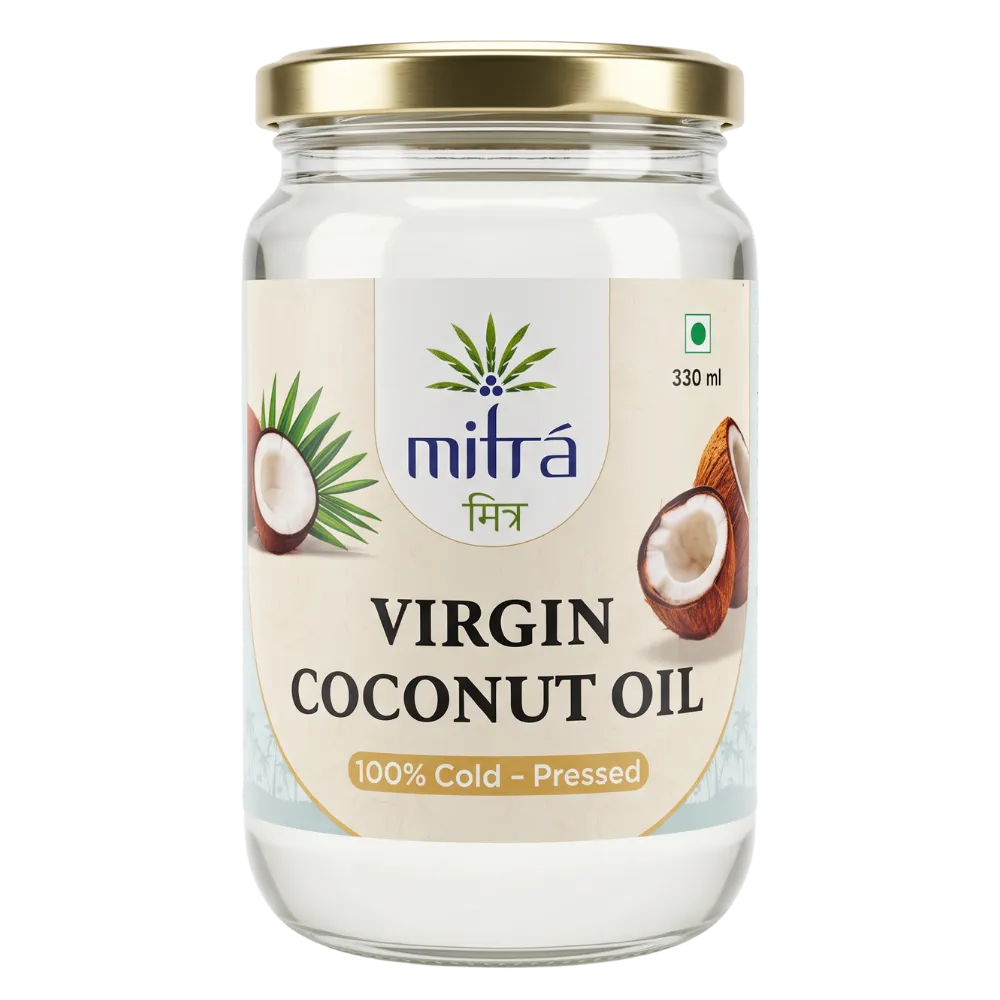
Mitra Cold Pressed Virgin Coconut Oil
Mitra Cold Pressed Virgin Coconut Oil
BUNDLE & SAVE
Couldn't load pickup availability
Mitra Cold Pressed Virgin Coconut Oil
Get it between - and -.
Description
Description
Mitra Cold Pressed Virgin Coconut Oil | Lab Tested Every Batch, Safe for Baby Massage | 100% Pure, 60% MCT, Keto, Cholesterol Free | Made from Fresh Coconuts | Cooking, Hair, Skin, Oil Pulling
- Lab Tested, Every Batch: Each batch is tested before dispatch for free fatty acid, peroxide value, moisture and pesticide residue. The batch number and pressing date are printed on every pack, so the age of the oil in your bottle is visible to you.
- Made from Fresh Coconuts: The coconuts are opened and shredded the same day, dried in a controlled dryer and pressed straight away. The oil is unrefined, unbleached and undeodorised. The ingredient list is coconut oil and nothing else.
- Pressed in Our Own Unit: We are the manufacturer, not a reseller. Coconuts are opened and shredded the same day, dried in a controlled dryer and pressed, which yields both virgin oil and coconut flour from the same nut. Unrefined, unbleached, nothing added.
- Gentle Enough for Baby Massage: Food grade with no fragrance, mineral oil or preservatives, which is why parents use it on infants. Warm a little in your palms and massage before a bath. Patch test a small area first, as with any oil.


-

Tested every batch
Before it leaves the unit
-

Fresh coconut
Opened and pressed the same day
-

Our own unit
Made in small batches everyday
-

Nothing added
All Natural Products


Our Latest Batch, in Numbers
Certificates describe our system. A lab report describes the oil itself. Here is the independent test report for a recent batch of Mitra Virgin Coconut Oil, with every result shown against the legal limit.
Mitra Virgin Coconut Oil
Match the batch number on your bottle to the batch on the report. Verify this report online with code E00D-1576-411C.
Acid Value (freshness)
0.27Peroxide Value (rancidity)
<1.5Moisture
0.08%Insoluble Impurities
NILPurity markers
All in rangeOne Oil, So Many Uses!
-

Cooking and tempering
Colorless and light with a mild coconut aroma, naturally rich in lauric acid, Mitra VCO suits everyday tempering, frying, and cooking the traditional way.
-

Scalp and hair
Strengthens hair from root to tip, reduces protein loss during washing, soothes a dry, flaky scalp, and adds natural shine with regular use.
-

Baby massage
Gentle enough for delicate baby skin, this pure oil is traditionally used for baby massage to soothe, nourish, and support healthy skin from day one.
-

Skin Moisturizer
Deeply moisturizes dry skin and cracked heels, absorbs quickly without a greasy residue, and its natural fatty acids help nourish and protect skin daily.
-

Makeup remover
Gently melts away stubborn makeup and waterproof mascara while nourishing skin with natural fatty acids, no harsh chemicals, gentle enough for sensitive skin.
-

Oil pulling
A traditional Ayurvedic morning ritual using pure coconut oil to help freshen breath and support everyday oral hygiene, naturally and gently.
-

Pet care
Soothes dry, itchy skin and adds natural shine to your pet's coat, its gentle fatty acids supporting healthy skin with regular care.
-

Wellness / Ayurvedic massage
Used for generations in Ayurvedic abhyanga, this pure, lauric acid rich oil calms the body, nourishes skin deeply, and supports traditional wellness rituals.


Mitra vs the rest
Five things that separate us from the rest
| Mitra | Others | |
|---|---|---|
Fresh coconut, pressed the same day |
||
Dry processed and expeller pressed |
||
No storage delay between harvest and pressing |
||
Naturally mild, authentic coconut aroma |
||
Latest Batch Test Lab Report |
Nut to bottle, in one day
We are the manufacturer, not a reseller. The same nut yields both the virgin oil and our coconut flour.


-

1. Bought whole
Whole coconuts from the Pollachi belt, some of the best coconut country in Tamil Nadu.
-

2. Opened the same day
Opened and shredded on the day they arrive, then dried in a controlled dryer rather than in the sun.
-

3. Pressed straight away
Into the expeller press. Virgin oil leaves one side, and the cake that becomes our coconut flour leaves the other.
-

4. Tested and stamped
Checked before dispatch, then the batch number and pressing date go onto the bottle.


The full label, in plain sight
- Fresh, not copra. We press coconut the same day it's harvested, not after weeks of drying and storage.
- One ingredient. Just raw coconut. No blending, no refining, no fillers.
- Made under FSSAI license (Lic. No: 10020042006803) at our own facility in Coimbatore, Tamil Nadu, part of India's coconut belt.
- A real address, not a P.O. box. S.F.No: 212/5a, Uthupalayam, Arasur Village, Sulur Taluk, Coimbatore, 641407, Tamil Nadu.
Four things we check before it leaves
Every batch is tested before dispatch, and the batch number and pressing date are printed on every pack. The age of the oil in your bottle is visible to you rather than to us alone.
From the kitchen to the skincare shelf, here's what our customers ask most
Everything About Your Mitra VCO
What's the difference between virgin coconut oil and regular coconut oil?
What's the difference between virgin coconut oil and regular coconut oil?
Virgin coconut oil is pressed from fresh coconut, not dried copra, and isn't chemically refined, bleached, or deodorised, so it keeps its natural coconut aroma. Regular or RBD (refined, bleached, deodorized) coconut oil is made from copra and processed further, which strips the aroma and gives a neutral-tasting oil.
Is virgin coconut oil the same as "cold pressed" coconut oil?
Is virgin coconut oil the same as "cold pressed" coconut oil?
Not exactly, and it's a common point of confusion. True cold pressing uses a hydraulic press with no heat at all. Most virgin coconut oil, including oil made by shredding and steam-drying fresh coconut before pressing (the dry process), is technically expeller-pressed rather than cold pressed in the strict sense. Many brands use "cold pressed" loosely as a consumer-friendly way of saying "minimally processed," so you'll see the term widely even when the process is closer to expeller pressing. What actually matters for quality is that it's made from fresh coconut rather than copra, and isn't chemically refined.
Why is Mitra VCO colorless instead of the golden-yellow oil I've seen elsewhere?
Why is Mitra VCO colorless instead of the golden-yellow oil I've seen elsewhere?
Pure virgin coconut oil is naturally clear and colorless when liquid, and white when solid. A golden or yellow tint in coconut oil usually points to a different raw material, added color, or oxidation, not extra purity. Colorless is the expected, higher-quality result, not a sign of anything missing.
Why does my bottle sometimes turn solid and cloudy, and sometimes stay liquid?
Why does my bottle sometimes turn solid and cloudy, and sometimes stay liquid?
Coconut oil naturally solidifies below about 24-25°C (76°F) and turns liquid above that. This is a simple, reversible physical change driven by room temperature, not spoilage, and it doesn't affect the oil's quality at all. In air-conditioned rooms or cooler months, expect it solid and white; in warm weather, it stays clear and liquid.
How do I turn solidified oil back to liquid?
How do I turn solidified oil back to liquid?
Stand the closed bottle in a bowl of warm (not boiling) water for a few minutes, or keep it in a warm spot, until it liquefies again. No need to microwave or heat it directly.
How long does virgin coconut oil last, and how do I know if it's gone bad?
How long does virgin coconut oil last, and how do I know if it's gone bad?
Properly stored virgin coconut oil typically lasts 2 to 3 years or more, since its high saturated fat content resists rancidity better than most cooking oils. Keep it tightly capped, away from direct sunlight and moisture. Signs it's turned: a sour, stale, or "crayon-like" smell, a bitter taste, yellowing, or any visible mold. If any of these show up, it's time to replace it.
Does it need refrigeration?
Does it need refrigeration?
No. Store it in a cool, dry place away from direct heat and sunlight; refrigeration just makes it solidify and harder to scoop or pour, without adding any shelf-life benefit for an oil this stable.
How do I do oil pulling with VCO, and for how long?
How do I do oil pulling with VCO, and for how long?
Take about a teaspoon of oil on a spoon and swish it gently around your mouth for 10 to 20 minutes without swallowing, then spit it out into the trash rather than the sink so it doesn't clog drains. Many people start at 5 minutes and build up gradually. It's traditionally done first thing in the morning, before eating or drinking, followed by your normal brushing routine.
Can coconut oil cause breakouts or clog pores?
Can coconut oil cause breakouts or clog pores?
For some people, yes. Coconut oil rates fairly high on the comedogenic scale, so those with acne-prone or oily skin sometimes find it clogs pores even though it's also moisturizing and mildly antibacterial. It tends to work better on dry skin, hair, and body use than as a daily face moisturizer for breakout-prone skin, so it's worth patch testing on the face specifically.
Does VCO actually help hair grow, or just make it look conditioned?
Does VCO actually help hair grow, or just make it look conditioned?
There isn't strong evidence that it speeds up hair growth, but there is real research showing it penetrates the hair shaft and reduces protein loss during washing better than mineral or sunflower oil. That's why regular oiling tends to leave hair feeling stronger and less prone to breakage over time, even without a growth effect.
Is coconut oil safe for babies?
Is coconut oil safe for babies?
Pure, unrefined coconut oil is widely used on baby skin and scalp, including for cradle cap, and is generally considered gentle for sensitive infant skin by pediatric sources. It's still good practice to patch test on a small area first and check with a pediatrician, especially for newborns or babies with an existing skin condition.
Does cooking with coconut oil destroy its nutrients?
Does cooking with coconut oil destroy its nutrients?
Virgin coconut oil is fairly heat-stable, with a smoke point of roughly 175-180°C (350°F), which comfortably covers everyday Indian cooking like tempering and sautéing. It holds up to heat better than many vegetable oils, though pushing any oil well past its smoke point in high-heat deep frying will degrade it over time.
Is it suitable for a keto or low-carb diet?
Is it suitable for a keto or low-carb diet?
Virgin coconut oil naturally contains medium-chain fatty acids, including lauric acid, which is part of why it's popular in keto and low-carb cooking circles. As with any dietary change, it's worth checking with a nutritionist if you're planning to make it a significant part of your daily intake.
Will using VCO on wooden cutting boards or furniture go rancid?
Will using VCO on wooden cutting boards or furniture go rancid?
Because it naturally resists oxidation, a thin conditioning layer on wood is generally fine and won't turn rancid the way some other cooking oils can. It's a traditional, food-safe way to nourish wood grain, best used as a light conditioning treatment rather than a permanent sealant.
Is virgin coconut oil safe for dogs?
Is virgin coconut oil safe for dogs?
In small amounts, yes, for most healthy dogs, both applied topically and, with a vet's go-ahead, mixed into food. Topically, working a small amount into the coat can help with mild dry skin and add shine; vets are clear it's better suited to cosmetic conditioning than treating actual infections or allergies. Dogs with a history of pancreatitis, weight issues, or an existing skin infection should get vet input before starting.